Early in my master's degree at the Royal College of Art, I was briefly radicalised by continental philosophy. Whether this was the self-preservative, knee-jerk reaction of a small-town Floridian attempting to fit in with the supposedly enlightened youth I had assumed filled art institutions, or a genuine attempt to understand what made me act as an artist, remains unclear. What is clear is that the catalyst for authentic, riveting art was simple and directly in front of me—I am, and have always been, a thoroughly observant and phenomenological person. If interrogating the mundane were an Olympic event, I would compete for England. My greatest fallacy, however, was the presumption that a literary understanding of phenomenology might provide a consistent and reproducible structure for my practice.
Heidegger defines phenomenology as an attempt "to let that which shows itself be seen from itself in the very way in which it shows itself from itself" (1962, p. 58). Although this offers an important hermeneutic framework—one that feels, and is, glaringly applicable to my work—the statement itself did not teach me how to work. Just as Professor Michael Rowe constantly reminded me, "What is the 'how' here?" (Rowe, 2026, personal communication). Ironically, it was within an academic arena that I discovered the answer: not following texts as scripture, but building a lived rapport with the objects to which those texts refer.
My earliest works began with something simple: a plastic water bottle sweating with condensation in the heat of a Florida summer. It was an observation unadulterated by the grip of a predetermined narrative. I noticed it, remained interested in it, and allowed that interest to lead somewhere, eventually precipitating into a collection of works aimed at immortalising the fleeting patterns generated by the primeval forces I experienced in South Florida. What was not apparent at the time, but is clear to me now, is that my success in making depended upon allowing myself the space to build a rapport with the pedestrian. Recognising this has been one of the most important developments in my practice. Fixed material processes need not apply, nor can theory establish the practice on my behalf. My method is simply to remain with the material world long enough for an object to make its demands known.
This exhibition examines the developments that have occurred since I returned to that method. My meteorological gaze remains, though it is now directed towards UV damage, exposure, and the lived provenance an object acquires through excess. Unlike the immediate disclosure of water and condensation, the sun's tirade materialises in far broader and less predictable ways: bleaching colour, embrittling plastic, and marking surfaces through prolonged exposure. This led me to select a viable host for the narrative: car bodies. I use the term "body" as more than a convenient metaphor, examining exposed automotive anatomy as a visual analogue for flesh.
"Flesh" arises within the practice in two principal ways. Primarily, it operates as a visual register of the offal-like, organic, and raw. At the same time, exposed flesh carries a history of opposing gestures: sacred and scandalous, revered and desired. By granting the automotive body a human character of its own, I can interrogate these tensions to an outlandish extent. The work consequently sits somewhere between the corporeal theatre of Mishima and Kishin Shinoyama (Shinoyama, 2020), and the iconic, neo-iconoclastic work of Andres Serrano (Serrano, 1987)—both major influences long before this particular body of work took form.
I draw no concrete conclusions from these investigations, but rather "revelations," as I flippantly refer to them. I value each work for the purpose it served within the flow state of its making, but I am equally interested in what it reveals retrospectively: the relationships, associations, and cached memories that subsist within objects. This exhibition traces those revelations through my developing relationship with the automotive body, considering how familiarity, exposure, and material transformation allow an ordinary object to become newly available to attention.
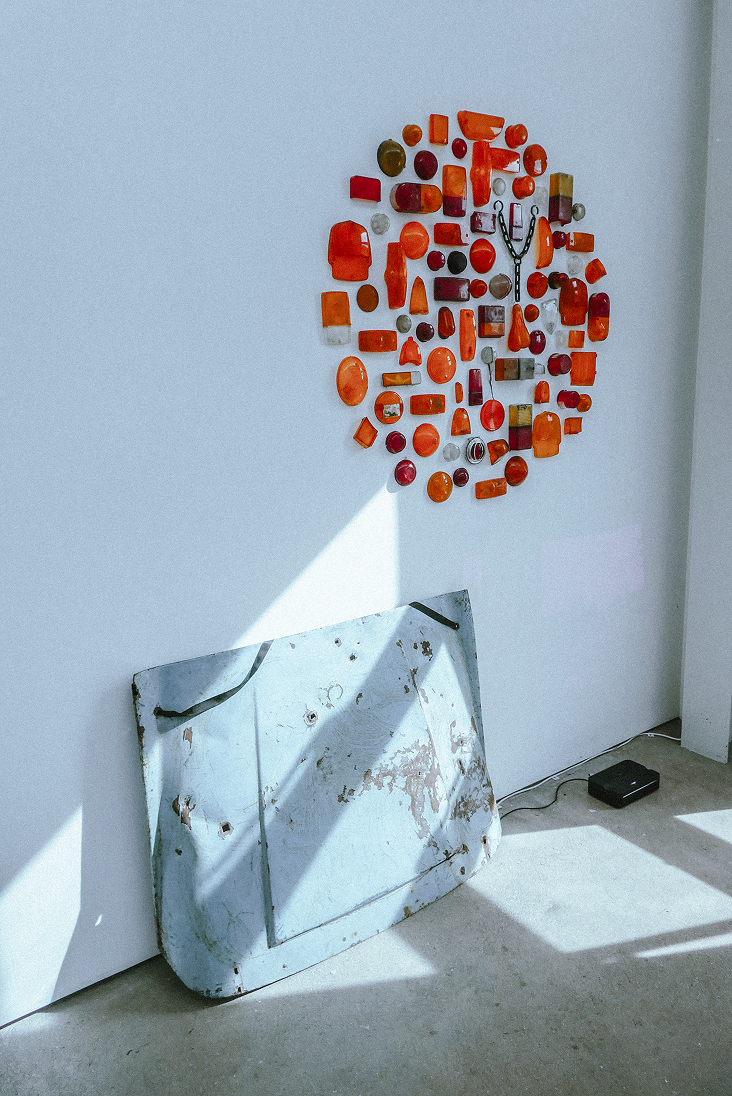
The interrogation of automotive bodies was perhaps as ad hoc as the water bottle on my bench had been. Following an exhaustive series of short-duration UV exposure tests on a variety of materials, I did everything short of throwing my hands in the air and abandoning the idea of solar damage. Whereas the effects of water had been near-immediate in my previous works, the gentle patina imposed by sunlight can take months, if not years, to become apparent. As part of my typical practice, I keep a shifting array of inspirational photographs on my bench. Among them was an image of an inconspicuous used sedan in a breaker yard, its body covered in large patches of chipped, sun-damaged paint.
At the time, this produced no epiphany. My bench was bare, my experiments had largely failed, and conceptual presentation deadlines were approaching. If anything, my descent into automotive bodies was a desperate attempt to maintain my footing. I had no goal beyond getting a relic of the elements onto my bench and witnessing what, if anything, might come of it.
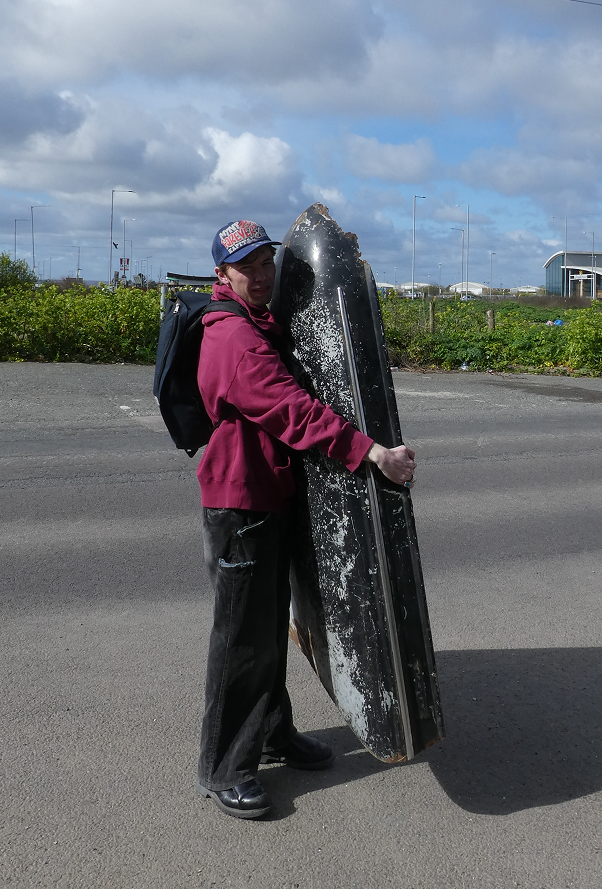
It was Easter Sunday when a man whom we will call John greeted me at the gates of an otherwise derelict farm on the Isle of Sheppey. Our paths had crossed after I responded to his advert on a car parts forum. Although I do not have the space to describe fully the impression made by John's character, he was exactly the person one might expect to be selling a weathered bonnet from a 1950s Humber Pullman hearse. Ironically, being carless, I faced the task of returning the bonnet to southwest London by train and on foot. This was not an intentionally artistic endeavour, but a practical one. After a thorough conversation about current events, currency exchanged, and bonnet in hand, John snapped a few parting photographs as I set off. From there, it was the bonnet and me against two miles on foot, two Southeastern trains, and two Underground transfers.
I credit this experience as the genesis of my bodily metaphor for cars. In retrospect, the venture appears distinctly Alÿs-esque (Alÿs, 1997), though in the moment it felt nothing short of ascetic. Three and a half stone of sharp, flaky, and rusted steel grated against my hips and hands. At times, I dragged it loudly behind me; at others, I held it against my waist. Audible remarks of "What the fuck is that?" from the Kentish denizens gradually gave way to the mildly bewildered stares of onlookers at Victoria Station.
Oddly, although I remained aware of the gawking, my greatest concern was not saving face, but losing the bonnet. The Tube's regulations concerning objects of this nature were unsurprisingly sparse. If a member of staff rejected me at the turnstiles, the journey was over. The immediate bond I formed with the bonnet, paired with the disruption that our proximity created, made the experience feel nothing short of carrying a body. In a way, I was. Just as the vehicle had once carried the deceased to their final resting places, I now carried part of its body towards a resting place of its own. Its scars were exposed to the wandering eye, alongside wounds of rust and pitting. The term "body panel" became uncannily literal.
My initial inclination was to cut the bonnet apart and use its sheet steel to make mourning jewellery. I was deep in Celeste Olalquiaga's The Artificial Kingdom: A Treasury of the Kitsch Experience, and particularly fascinated by her idea of "melancholic kitsch": an aesthetic bound to the mourning of a past that can never be recovered (Olalquiaga, 1999, p. 291). A black, chipping, British-made hearse bonnet appeared to offer a perfect late-capitalist metaphor for the Whitby jet of yesteryear. Notwithstanding the strength of the idea—and the possibility of returning to it at a later date—the concept gave way once I began to recognise other parts of the car's anatomy. In particular, the indicators.
If the acquisition of the bonnet was Coppola's The Godfather (1972), my descent into automotive indicators was The Godfather Part II (Coppola, 1974): the rare sequel that surpassed the original. The progression to lenses itself is quite a natural evolution. It was the lines of thought conjured through the indicators that effectively elevated the car body into a body of work.
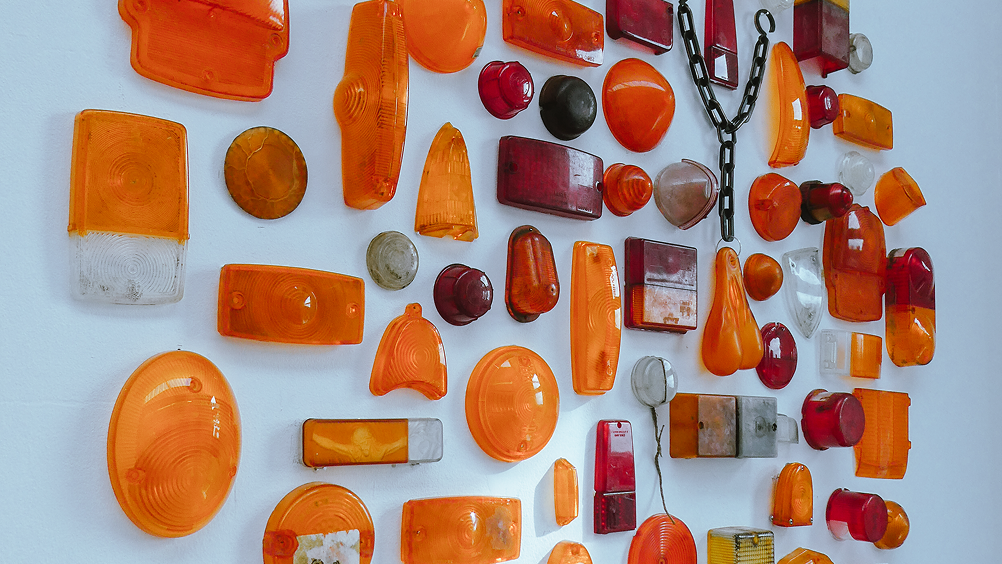
Just as with the bonnet panel, the potential of indicators did not immediately jump out at first contact. It was a slow burn, initially contingent on what was available at the Nine Elms Market on Sunday mornings. Growing restless from the lack of variety, I ordered a few random job lots of vintage lenses online, before shifting to scouring breaker yards, some as far north as Yorkshire. With variety came archiving, preference, and selectivity. Removing indicators from their pedestrian stasis—attached to vehicles—created a space where I recognised them as an untapped feat of industrial design. The sunbursts of the Fresnel lenses paralleled the guilloché work of the Fabergé pieces I once handled, both in pattern and in holographic effect.
With sustained attention, the gaze shifted from practical and design-centric into something I can only describe as intuitive pareidolia, hyperbolised by the wandering mind. I saw faces in cars, and I will presume that it is a phenomenon not exclusive to me. The grille is the mouth, and the indicator lenses are the eyes, of course. Flippantly referring to the fogged-up lenses as "cataracts" inadvertently planted the seed of a far more radical notion in my head—if eyes are the windows to the soul, then what may live in the soul of this body? Is it that of man, and his deepest, darkest desires? God? If "God created mankind in his own image" (Genesis 1:27, New International Version), and mankind created this body, does that mean this object is just as fallible and sensitive as we are? It mirrors the sense of cosmic awe I derived from Kerouac's "…don't you know that God is Pooh Bear?" (Kerouac, 1957, p. 307) line. If I am so self-righteous as to project my image onto this unconsenting object, then it cannot be an unreasonable notion to push the image in its entirety.
Funnily enough, my first and arguably favourite piece in the collection, Houses of the Holy, was not made from an actual indicator. My neurotic dissection of lenses led me to digitise and create my own via stereolithography. I had a similar two-tone Peugeot 104 lens that was unfortunately too large for a brooch, as it ticked the many boxes I was after: long, a sunburst pattern, and a main "window" with a smaller one to the side.
From a design standpoint, the passion of Christ was low-hanging fruit, as the lens was begging for someone or something to adorn its many halos. The woman, whose identity I will not disclose, was the product of an immature wandering mind. "Why not put a naked lady?" was likely the exact thought process I had. Once both images were superimposed onto the plastic, however, the tension between the two just, well, worked. Both figures strike a similar, visceral pose; the line where the pain becomes pleasure is not entirely clear. As sacrilegious as it seemed to employ this duet, the two reflected the duality not only of the nude figure, but the psyche of man.
The latter is perhaps the misconception of my work that concerns me most: that placing Jesus beside pornography is, in itself, an attack. Andres Serrano famously faced similar accusations over Immersion (Piss Christ) (1987), despite stating that the work reflected him “not only as an artist, but as a Christian” (Serrano, cited in Holpuch, 2012). In my own case, I reflect on Karl Marx's claim that "religion is the opium of the people" (Marx, 1970, p. 131). The only revision I offer in 2026 is that pornography and religion are interchangeable. The car lens completes the trinity: religious fetish, sexual fetish, and commodity fetish, all housed within a single object of worship.
The same premise underpins St Sebastian, in which the saint is encased within a Hillman Husky lens. The choice is not entirely innocent: Saint Sebastian has long doubled as martyr and erotic object, a tension made explicit in Mishima's Confessions of a Mask (originally published in 1949; Mishima, 1958) and later embodied by Mishima himself when he posed bound and pierced by arrows for Kishin Shinoyama in 1970 (Shinoyama, 2020). The viewer is free to draw their own conclusions; my intention is not to dictate a moral position, but to place these uncomfortable human tensions within a body that is neither sacred, sexual, nor human.
The word "indicator" became an important element in the creation of this body of work, ultimately giving rise to the multiple entendres exhibited throughout it. Michael Rowe noted that indicators tend to make us stop, even when removed from a vehicle (Rowe, 2026, personal communication). Few materials are naturally endowed with such authority over the gazing eye, which placed considerable responsibility on what I intended them to say. What might indicators, reflectors, and signals indicate, reflect upon, or signal when removed from their usual vocation of alerting other drivers? They are particularly effective communicators within that narrow role; I wanted to discover what they might say when granted the faculty to address conflicts far beyond the road.
Nuts, for instance, takes a ubiquitous Floridian truck ornament, often associated with macho, high-testosterone culture, and pairs it with a waist-worn, rosary-style chain. Although visually bold, I intended the title to guide the viewer. At the bottom sits a pair of testicles—or "nuts," as they are colloquially known—joined by a chain that hinges on a nut in the industrial sense, with the added implication of "nut" as ejaculate: the genesis of life. By removing the object from its aggressively secular context and placing it within religious iconography, it is made to speak in ways it never could have from the back of a tailgate. The irony, of course, is that the gesture becomes outlandish when worn on the body, while bolting a pair of testicles to a truck—granting it a reproductive anatomy of its own—is treated as perfectly ordinary.
A brooch like Orb, on the other hand, relies less on nomenclature and more on iconography. As an American, I have no dog in the topical battle over the monarchy and its place within modern British society. I cannot, however, ignore the title of The Sovereign's Orb, an object whose very name asks us to yield. Yet despite its weathered bezel, foggy lustre, and hairline fractures, the brake indicator surprisingly holds far greater power to command obedience on this earth. If it did not, many of us would end up injured or dead.
On the subject of modern British society, the initial exhibition of this work was accompanied by a short film I produced. Inspired by my own bout with the hearse bonnet, and conveniently engaging with both Chaucer's The Canterbury Tales (Chaucer, 2003) and Powell and Pressburger’s A Canterbury Tale (1944), I found a documented pilgrimage a suitable means of offering an updated commentary on present-day England.
The journey begins with a troubled man—myself—smoking cigarettes and huffing poppers outside the Ann Summers sex shop in Soho. Ducking into an alley to urinate, I discover a discarded bonnet and begin to investigate. By the time the camera pans back up, I am dressed in clerical garb. From there, I carry the bonnet on my shoulder through central London, Peckham, and into Kent. Between new builds, across moor and meadow, and along the coast, I ultimately arrive at a modern Canterbury, where I leave the bonnet at the gates of the cathedral.
Although the ending was intentionally open-ended, I aimed to present a candid view of England as I encountered it, all while carrying a relic of its past: the bonnet of a Triumph TR3.
The revelations of this story need not include seven seals, nor do I believe it deserves a mark as low as that of a beast. There are, however, a few final judgements to be made. The greatest personal achievement I take from this body of work is that I remain critical of it. It is important not to conflate this criticality with regret, but rather to treat it as a sentiment towards what I would do differently if I began now. Just as the proverbial man never crosses the same river twice, an artist can only view their works as a fleeting souvenir of a time past. Writing about my work was the greatest instrument in probing my own criticality. Frankly, I did not decide to write about my work as a self-prescribed reflective means of understanding, but rather in response to a couple of magazines who were interested in hearing more. This was the first occasion on which any exhaustive writing was produced about the body of work as a whole. It was here that I started to realise my concept was not flawed, but was likely making my life and practice harder than it needed to be.
The interrogation of the pedestrian—car bodies, in this instance—is a wondrous virtue. The ambitious and abstract leap to view the lenses as mirrors to the soul of this body, however, is where my discipline as an artist was immensely challenged. Remaining within the bounds of corporeal iconography, double entendres, and religion proved the only means of creating a cohesive, legible selection of jewellery. In a way, the unhinged metaphysics behind the concept were more binding than liberating.
A far more accessible alternative, which exists as my current de facto understanding of these works, is the car as a latent body, with the figurative "eyes" recalling the memories of its surroundings.
This evolution in understanding came to me through music, of all sources. The band Car Seat Headrest took its name from lead singer Will Toledo, who found privacy in his car during early recordings (Crane, 2020). Songs: Ohia's ‘Whenever I Have Done a Thing in Flames’ builds its close around a screen-door-like squeak, looped until it becomes rhythm rather than noise (Songs: Ohia, 2000). What these have in common is not the pedestrian itself, but the proximity of the pedestrian to something visceral. Much like hotel rooms, cars see the full range of a person. They witness the best days and the worst. I have cried in mine. People pray in them, and people fuck in them. Occasionally, someone is born in one. As a Floridian who has driven I-4, America's deadliest highway (Teletrac Navman, 2021), I have witnessed my share of gruesome wrecks. For a machine so painfully secular, the car functions as a genuine vessel: a final altar en route to the great beyond. This, I think, is a far better lens through which to understand what I am after in this work: not a body pretending at sanctity, but a confessional that asks nothing of a man except his proximity—the great equaliser of his true self.
As for the technique and deployment of future works, I cannot shake the reception of my exhibition space during my graduate show. The most common question I received, bar none, was "which programme are you part of?" Prospective buyers seldom enquired about individual pieces—rather, they asked about the pricing of the entire installation. The Dorfic spectacle I created was nothing short of an impromptu curation miracle. Although the response to the installation was humbling—and likely contributed to my commendation for the Chris Massey Award for Interdisciplinary Practice—it was also a gentle punch in the gut to have sacrificed so much for the jewellery, only for the space to receive more attention than the pieces themselves. Subsequently, my work between the short run of the show and the moment I write these words has gone in all directions. I am in the process of using larger amber highway maintenance lenses to create home and industrial lighting. Juxtaposed against that, I am drafting various "everyday driver" designs for silver jewellery. The content of the work and ubiquity of automotive accoutrements grant me the prerogative to experiment with many different routes with seemingly viable outcomes, all without forsaking these roots in art jewellery. As I see it, none of these routes need be mutually exclusive.
References
Alÿs, F. (1997) Paradox of Praxis 1 (Sometimes Making Something Leads to Nothing) [performance]. Mexico City.
Chaucer, G. (2003) The Canterbury Tales. Translated by N. Coghill. London: Penguin Classics.
Coppola, F.F. (1972) The Godfather [film]. United States: Paramount Pictures.
Coppola, F.F. (1974) The Godfather Part II [film]. United States: Paramount Pictures.
Crane, L. (2020) ‘Will Toledo of Car Seat Headrest: Tape Op Podcast Interview’, Tape Op. Available at: https://tapeop.com/interviews/bonus/will-toledo-car-seat-headrest (Accessed: 24 July 2026).
Heidegger, M. (1962) Being and Time. Translated by J. Macquarrie and E. Robinson. Oxford: Blackwell.
Holpuch, A. (2012) ‘Andres Serrano’s controversial Piss Christ goes on view in New York’, The Guardian, 28 September. Available at: https://www.theguardian.com/artanddesign/2012/sep/28/andres-serrano-piss-christ-new-york (Accessed: 24 July 2026).
Kerouac, J. (1957) On the Road. New York: Viking Press.
Marx, K. (1970) Critique of Hegel’s ‘Philosophy of Right’. Edited by J. O’Malley. Translated by A. Jolin and J. O’Malley. Cambridge: Cambridge University Press.
Mishima, Y. (1958) Confessions of a Mask. Translated by M. Weatherby. New York: New Directions.
Olalquiaga, C. (1999) The Artificial Kingdom: A Treasury of the Kitsch Experience. London: Bloomsbury.
Powell, M. and Pressburger, E. (1944) A Canterbury Tale [film]. United Kingdom: The Archers.
Serrano, A. (1987) Immersion (Piss Christ) [Cibachrome photograph]. Available at: https://andresserrano.org/series/immersions (Accessed: 24 July 2026).
Shinoyama, K. (2020) Yukio Mishima: The Death of a Man. New York: Rizzoli.
Songs: Ohia (2000) ‘Whenever I Have Done a Thing in Flames’, on Protection Spells [sound recording]. Bloomington, IN: Secretly Canadian.
Teletrac Navman (2021) ‘Most Dangerous Roads in America Infographic’, Teletrac Navman. Available at: https://www.teletracnavman.com/fleet-management-software/telematics/resources/most-dangerous-roads-in-america-infographic (Accessed: 24 July 2026).